How Bob Dylan Helped to Influence John Lennon’s ‘Norwegian Wood’
John Lennon and Bob Dylan came from entirely different corners of the world, both geographically and emotionally. Lennon thrived on being the sardonic ringleader in a band, while Dylan functioned more like a lone big cat, enigmatic and only seen when he desired.
And yet in many ways, they mirrored one another, and this became clear as their respective careers developed through the '60s.
"I like him personally," Lennon said to David Sheff in 1980. "I've known him for years."
In other words, it's like the saying goes: game recognizes game.
How the Beatles First Met Dylan
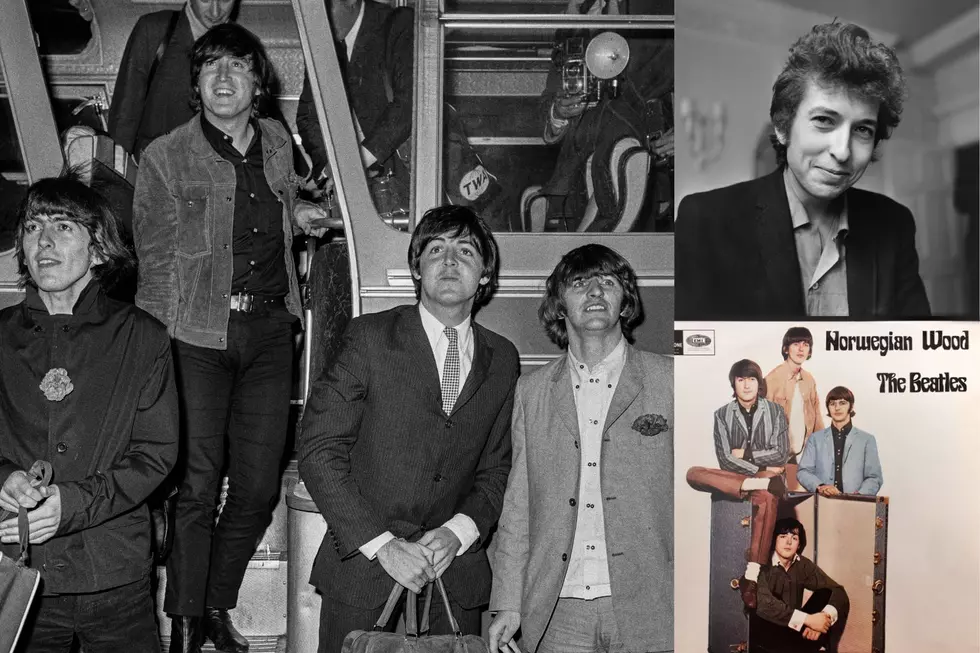
Arguably one of the most famous stories in rock 'n' roll history is the first meeting of Dylan and the Beatles. After many months of hearing one another's work, they finally crossed paths in person in August of 1964, at which point Dylan introduced the Fab Four to a little something called pot.
"I don't remember much what we talked about," Lennon later said of the meeting, as quoted in the Anthology book. "We were smoking dope, drinking wine and generally being rock 'n' rollers and having a laugh, you know, and surrealism. It was party time."
Pot was by no means the only thing Dylan turned the Beatles on to, and this was especially true for Lennon.
'Norwegian Woods' Words
In today's world, the concept of an artist leaning on their written words is normal, but it's important to remember that at this time in musical history, things were much more separate. What one might write in a book or in a poem would not be used for a song and vice versa.
But when Dylan came along, he helped pioneer the idea that poetry and songwriting could go hand in hand, even if the content wasn't logical or the meaning wasn't clear. A listener could use their own imagination to draw conclusions.
"We've gone past those days when we wouldn’t have used words because they didn't make sense, or what we thought was sense. But of course Dylan taught us a lot in this respect," Lennon explained to Rolling Stone in 1968. "Another thing is, I used to write a book or stories on one hand and write songs on the other. And I'd be writing completely free form in a book or just on a bit of paper, but when I'd start to write a song I'd be thinking dee duh dee duh do doo do de do de doo. And it took Dylan and all that was going on then to say, oh, come on now, that's the same bit, I'm just singing the words."
READ MORE: Top 60 Beatles Collaborations
In the case of "Norwegian Wood (This Bird Has Flown)," Lennon chose to write about an extramarital affair he was having – though with whom he later said he could not recall — and he employed this approach to his songwriting. It resulted in lyrics that were more literate, surrealist and almost absurd. Did he literally mean he slept in the bathtub? Why aren't there any chairs in the room? None of that matters. "Norwegian Wood" then feels more like a dream sequence than a pop song.
"I'd always had some kind of affairs going," Lennon told Sheff in 1980, "so I was trying to be sophisticated in writing about an affair, but in such a smoke-screen way that you couldn't tell."
Listen to the Beatles' 'Norwegian Wood (This Bird Has Flown)'
And if there was one person who knew something about writing with a smoke-screen, it was Dylan.
"I just know in my own mind that we all have a different idea of all the words we're using," he said at a 1965 press conference (via Rolling Stone). "Y'know so I don't really have too much – I really can't take it too seriously because everything – like if I say the word 'house' – like we're both going to see a different house. If I just say the word – right? So we're using all these other words like 'mass production' and 'movie magazine' and we all have a different idea of these words too, so I don't even know what we're saying."
Paul and George's Contributions
When Lennon brought "Norwegian Wood" to his bandmates, there was still work to be done. But Paul McCartney swiftly did as Paul McCartney does.
"I came in and he had this first stanza, which was brilliant: 'I once had a girl, or should I say, she once had me,'" he recalled for Paul McCartney: Many Years From Now. "That was all he had, no title, no nothing. I said, 'Oh yes, well, ha, we're there.' And it wrote itself. Once you've got the great idea, they do tend to write themselves, providing you know how to write songs."
READ MORE: The 'Big 4' of Beatles Albums
"Norwegian Wood" thus became a Lennon-McCartney composition, though George Harrison also brought his touch to it.
It was Harrison, freshly influenced at the time by Eastern music, who had a locally-purchased sitar with him.
"It was a real crummy-quality one, actually, but I bought it and mucked about with it a bit," he said for Anthology. "We would usually start looking through the cupboard to see if we could come up with something, a new sound, and I picked the sitar up – it was just lying around; I hadn't really figured out what to do with it. It was quite spontaneous: I found the notes that played the lick. It fitted and it worked."
That decision ultimately meant that "Norwegian Wood" marked the first appearance of a sitar on a Western rock recording.
Dylan's Response
"Norwegian Wood" appeared on Rubber Soul, released in December of 1965. Less than six months later, a song called "4th Time Around" appeared on Dylan's 1966 album, Blonde on Blonde. The similarities were more than apparent, both in their lyrical style and the phrasing of the vocals.
Listen to Bob Dylan's '4th Time Around'
Dylan personally played the song for Lennon on one of his trips to London, though exactly when is unclear.
"He said, what do you think?" Lennon remembered in 1968. "I said, I don't like it. I didn't like it. I was very paranoid. I just didn't like what I felt I was feeling — I thought it was an out and out skit, you know, but it wasn't. It was great. I mean he wasn't playing any tricks on me. I was just going through the bit."
READ MORE: Bob Dylan Album Opening Songs Ranked
"Norwegian Wood" opened a door for Lennon, whose songwriting would only continue to evolve. He and Dylan remained kindred spirits in the years that followed, praising one another when brought up in interviews.
"Oh, I always love to see John," Dylan said to Rolling Stone in 1969. "Always. He's a wonderful fellow."
"If I was in New York, he'd be the person I'd most like to see," Lennon said in '68. "I've grown up enough to communicate with him. Both of us were always uptight, you know, and of course I wouldn't know whether he was uptight, because I was so uptight, and then when he wasn't uptight, I was — all that bit. But we just sat it out because we just liked being together."
How the Beatles' 'Rubber Soul' Influenced These 15 Artists
Gallery Credit: Allison Rapp
More From Ultimate Classic Rock