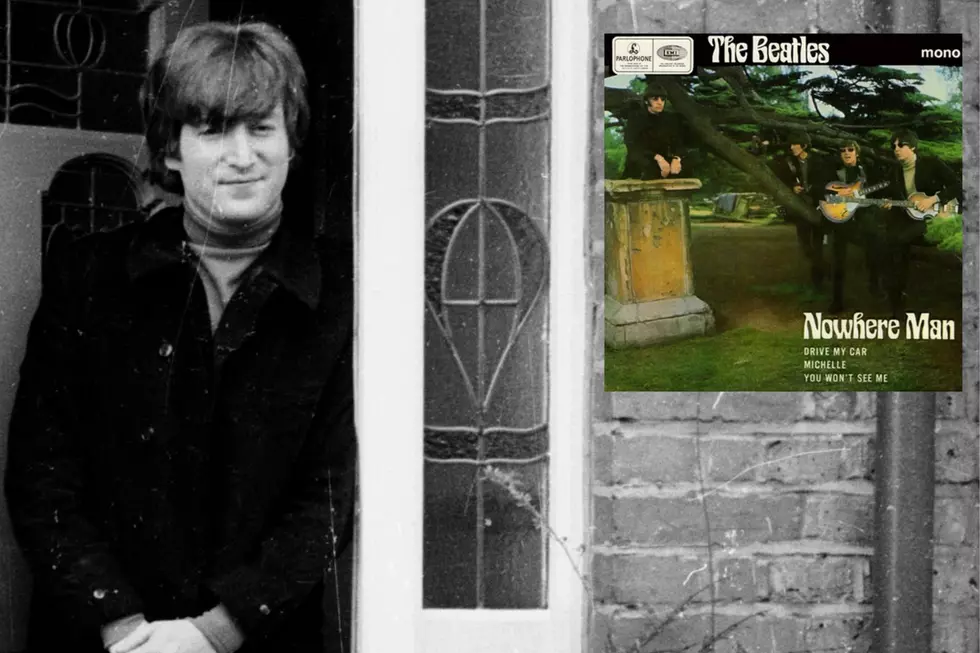
How John Lennon Came Up With ‘Nowhere Man’ After Five Hours of Nothing
In the mid '60s, the Beatles were still very much together, but not necessarily on the exact same page.
Ringo Starr was a brand new father, happily soaking in the many blisses of domestic family life, while George Harrison was falling deeper into his studies of Eastern music and philosophy. Paul McCartney was investing his time into London's cultural scene — art galleries, operas, etc.
John Lennon's experience, however, was less stimulating, at least emotionally. He lived in Weybridge then, just far enough outside London for there not to be very much day-to-day excitement. He was regularly taking LSD and his relationship with wife Cynthia and son Julian was, in a word, deteriorating.
"I can get up and start doing nothing straight away," he told the journalist Hunter Davies in 1967 (via American Songwriter). "I just sit on the step, look into space, and think until it's time to go to bed. … If I am on my own for three days, doing nothing, I almost leave myself completely. I'm just not here. … I'm up there watching myself, or I'm at the back of my head. I can see my hands and realize they're moving, but it's a robot who's doing it."
Five Hours of Nothing
This catatonic state of being didn't help Lennon's creative drive, until it did one day.
"I'd spent five hours that morning trying to write a song that was meaningful and good and I finally gave up and lay down," he later recalled to David Sheff. "Then 'Nowhere Man' came, words and music, the whole damn thing, as I lay down."
READ MORE: The Beatles' 'Rubber Soul': A Track-by-Track Guide
In 1971, Rolling Stone asked Lennon if the song was meant to be about anyone in particular.
"Probably about myself," he answered. "I remember I was just going through this paranoia trying to write something and nothing would come out so I just lay down and tried to not write and then this came out, the whole thing came out in one gulp."
Listen to the Beatles' 'Nowhere Man'
Even then, Lennon didn't share the song's inspiration with McCartney.
"When I came out to write with him the next day, he was kipping on the couch, very bleary-eyed," McCartney said for Many Years From Now. "It was really an anti-John song. He told me later, he didn't tell me then, he said he'd written it about himself, feeling like he wasn't going anywhere. I think it was actually about the state of his marriage. It was in a period where he was a bit dissatisfied with what was going on; however, it led to a very good song. He treated it as a third-person song, but he was clever enough to say, 'Isn't he a bit like you and me?' – 'me' being the final word."
In the studio, the Beatles chose to push the boundaries of what "Nowhere Man" could sound like, not accepting "no" as an answer.
"We were always forcing [the Abbey Road staff] into things they didn't want to do. 'Nowhere Man' was one," McCartney later said (via The Complete Beatles Recording Sessions: The Official Story of the Abbey Road Years 1962-1970). "I remember we wanted very treble-y guitars, which they are, they're among the most treble-y guitars I've ever heard on record. The engineer said, 'All right, I'll put full treble on it,' and we said, 'That's not enough,' and he said, 'But that's all I've got, I've only got one pot and that's it!' And we replied, 'Well, put that through another lot of faders and put full treble up on that. And if that's not enough we'll go through another lot of faders.'"
READ MORE: Top 20 Acoustic Beatles Songs
The engineer in question was Norman Smith, who would later work on several albums with Pink Floyd. He was with the Beatles from the beginning, working on every one of their EMI studio recordings.
"Up to that time we'd had a kind of family setup between the four guys, George [Martin], and myself," Smith once explained to Sound on Sound. "It was superb, and you can probably imagine what a great time it was to be part of all that. Also — and I don't want to take anything away from anyone — production of the Beatles was very simple, because it was ready–made. Paul was a very great influence in terms of the production, especially in terms of George Harrison's guitar solos and Ringo's drumming. It was almost like we had one producer up in the control room and another producer down in the studio, and of course John Lennon also knew what sounds he wanted."
The album "Nowhere Man" appeared on, Rubber Soul, wound up being the last Beatles album Smith contributed to. Things were beginning to change within the band in terms of leadership, decision-making and general hierarchy. The band's insistence on the treble was a good example of them taking even more authority over their recordings.
"Anyway you'd then find, 'Oh, it worked!'" McCartney said of that process with "Nowhere Man." "And they were secretly glad because they had been the engineer who'd put three times the allowed value of treble on a song. I think they were quietly proud of all those things."
The Stories Behind Every Beatles LP Cover
Gallery Credit: Nick DeRiso
More From Ultimate Classic Rock