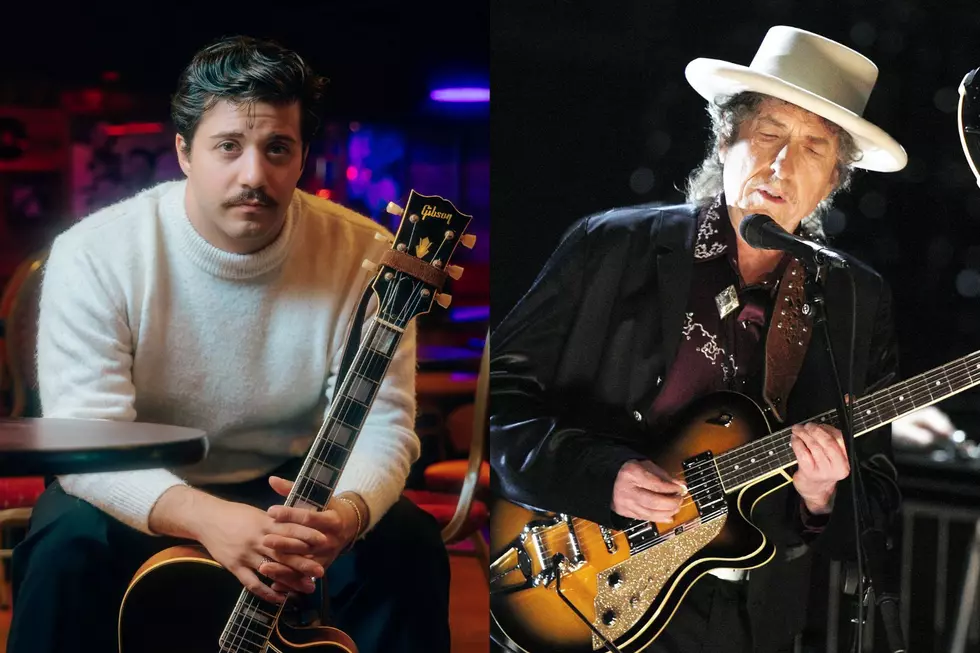
What Jad Tariq Learned From Playing Guitar With Bob Dylan This Summer
Jad Tariq, a Memphis-based rhythm & blues guitarist and vocalist, has been writing, recording and gigging since he was a kid in Connecticut, building a following for himself locally and helping to usher in what some might consider a new wave of contemporary blues music.
But not many people Tariq's age — he turned 30 years old this year — get the kind of phone call he did earlier this summer. It came from Bob Dylan's team, asking if he'd like to come play a few shows with the band on tour. He accepted.
As fans are well aware, Dylan has a habit of both sticking with players he's worked with for years and also switching things up unexpectedly. But Tariq appeared to slip in naturally, trading parts with Dylan's other electric guitarist, Joel Paterson, and generally sounding like he'd been in the band for much longer than a few weeks. (This writer can personally attest to that having attending the band's 2026 performance at Forest Hills in New York City, which Tariq described as "one of my favorite shows I think I've ever played" with his family in town to catch the action in person.)
We recently caught up with Tariq to talk both Dylan and Tariq's own new album, Precious Company.
I realize you can't share everything, but can you walk me through how you were contacted and asked to play with Dylan?
I had gotten a call from his team about coming out and playing, which, you know, of course I was excited to do. But I was on the road with [blues harmonicist] Charlie Musselwhite, so they had called and I was, at that time, working with Charlie and it worked out that I could come do a couple shows a few weeks later, and that's kind of how that happened. I wish there was some kind of, like, fun story to tell here but it was really just one of those things. It was kind of just like getting called for any job, you know? You just get the call and if you can make it, you can make it and if you can't, you can't. And it just worked out that after I got off the road with Charlie there was of couple dates that I was able to do and I went and did 'em.
READ MORE: Bob Dylan in 85 Quotations
Did you feel surprised? Nervous?
Yeah, I did feel surprised just in the sense that, like, I guess that wasn't on the list of calls I would expect to get, you know what I mean? Not so much of like, nerves or anything like that. I mean, of course, there are some nerves for any gig that you do. But it just wasn't a call I was expecting to get, but of course, was happy to get.
What happened then? Did you go right to rehearsals?
There wasn't a whole lot of prep. The Bob fan base is — I mean, they're real...what's the word I'm looking for? Let's just say: thorough. It's easy to find, you know, what songs he'd been doing on the road, so I kind of just familiarized myself with the songs that he had been doing on that run.
But other than that there wasn't a whole lot of prep. I flew out to meet them and we did a small little rehearsal the day before the first show — or I can't remember if it was the day before or the day of. I think it was the day before the first show and it was a real relaxed rehearsal. It was just all of us, you know, in a room and we just sat down and they basically showed me the set and the arrangements that they were doing. I already was kind of familiar with the tunes anyway, so it wasn't too crazy. I'm called in so many situations like that where you get a call, like, a day before or a week before a show and you kind of just listen to the music, try to internalize it as much as you can and hopefully get a rehearsal if you can. Sometimes you don't.
It's funny because I saw you perform with the band at the Forest Hills show in New York City, and it sounded seamless. You'd never guess you'd only been playing together for a few weeks at that point.
Those guys are just so good. Anton Fig on the drums is just a maniac, Tony [Garnier] the bass player has been with Bob forever. So it was pretty easy to just pop in. And also like, Bob is – people don't realize Bob can really get around on the piano. I don't think a lot of people know he's actually, you know, he's pretty damn good at playing piano. And he plays in tough keys, too, for a piano player. Like he really knows his instrument well, he's got a cool ear and just really cool musical ideas. It was easy to play with them.
Watch Jad Tariq Perform With Bob Dylan in New York City
What about before you were called to do these gigs? Were you a fan of Dylan's?
I mean, just being a musician, I was obviously familiar with his work. I feel like everybody is sort of familiar with his work, to a degree. I wouldn't say I was like a fan, per se, and that's — I mean, I've always liked his music. I wouldn't say that at the time of him calling me — I wasn't, you know, an everyday listener, but I've always enjoyed his music and of course had a lot of friends who were huge fans. So you know, I was a hip to his records and I liked all his stuff. But I mostly always listened to kind of like, straight ahead blues and that was kind of more of my daily listening stuff.
Did playing these shows change your perspective on that?
Honestly, playing with him and just digging into the material made me like his music even more than I already did. It was a really fun experience and I just admire his creative mind and just the way he works. So yeah, I definitely like his stuff even more now than I did before.
You know, I especially like the records he did with all the standards, the jazz standards. [Dylan released three albums of standards between 2015 and 2017: Shadows in the Night, Fallen Angels and Triplicate] Man, I thought that — I mean, it's really hip, and I thought that the way he delivers a lyric and phrases. ... He's really a killer singer. I mean, he's got a really unique thing, but most importantly, like that record, he's really delivering the lyrics. I think it's kind of one of the better standards albums I've heard.
Did you have a particularly favorite song to play in the set list?
Ooh, yeah, there's a bunch I really liked. "False Prophet" was always real fun. And the arrangement, you know, between the first couple shows I did with him and the last, I think the arrangement and the key might have changed a couple times. That was always really fun. "When I Paint My Masterpiece," that was a really fun one. That was very different from the recorded version, and that was kind of the highlight.
READ MORE: 20 Different Takes on Bob Dylan's Most-Covered Song
What would you say was the most important thing you learned from this experience playing with Bob?
Well, I think with any song...when you're doing the sideman thing — because, you know, I do the sideman thing and the frontman thing, so I live in two different worlds — but I notice when I'm a frontman there's certain threads of a song, and I always call it kind of the nucleus or the seed of a song, and that's the most important thing always. Like whatever you're doing has to be — there are certain elements that have to be there whether it's a groove or a lick or a lyric, usually. Every song has that, like, very small center point in it that is the song, you know? And I think finding out — you got to use your instinct on that. Taste is different between everybody of course, but trying to figure out what that tiny seed of the song is and doing your best to support that thing. I know that's kind of, like, an abstract concept, but you know every song has it and sometimes it's not even something that's describable. But finding out what that thing is and how to best serve it and really sell the song. I think that's what I want to hear when I have sidemen working for me.
Speaking of being a frontman, let's talk a little about your new album, Precious Company. I'm curious if you think of yourself as a guitarist first and then a songwriter, or the other way round?
Ooh, I don't know because I've always been writing songs. I don't think I think of myself enough to answer that question. [Laughs]
Where do you get that nucleus from for your own songs? Where do your ideas tend to stem from?
It can be anything. I think the biggest thing — well, you know, life events I think, Breakups, life changes. I mean, there's so many things that go into it. I would say more often than not, it's something I hear in a conversation. Like I'll hear somebody say something or I'll overhear something. Or I'll be in a conversation and somebody will say something and they'll say a line, I'll be like, "Ooh, I gotta write that down." And I always do. Constantly throughout the day I'm writing little notes on my phone with song ideas and usually the thing I write down tends to be the nucleus of the song, like that tends to be the thing that I kind of expand around. I mean, I never write the music first. I always write the lyrics first.
Listen to the Title Track to Jad Tariq's 'Precious Company'
Yeah, I was going to say...there's quite a few heartbreak-related songs on here. Are you alright? [Laughs]
[Laughs] I am. I am alright. It was definitely kind of a breakup record, I had gone through a breakup and that for sure influenced a lot of the material on the record.
But it's not a sad record, I don't think.
I wouldn't call it a sad record either. I would say maybe it's an inspired record. You know, whether or not I think about myself as a songwriter or a guitar player, it's not a guitar record. I'm not really a big fan of just guitar records, even though I'm probably primarily known as a guitar player. I think all of the songs on the record kind of stand on their own. They all have a lyric, it's not just an excuse to, like, blaze a guitar solo. They're all kind of lyrics that I had felt and thought out and wrote and I think the guitar kind of, if anything, is still just supporting that as opposed to doing a full blown guitar record.
I'm quite curious to hear your thoughts on this, because I feel like we're kind of entering a new era of neo blues music, you know? It's been building for a while — a few years ago it was that John Mayer vibe, which then evolved with people like Gary Clark Jr. or Buffalo Nichols, for example. And then there was the music in Sinners, Buddy Guy and all that. It seems like it’s really reached new, younger audiences, and you're a part of that.
We've all been saying that for sure, we've all been noticing it. It seems like there's a lot of that, like, retro soul — I hate the word "retro," but for lack of a better word. I feel like retro tends to be used more to describe, like, the soundscape of the music more than the actual content. I mean, it's like, if something's a little bit more lo-fi and doesn't have 808 sub bass, it's retro, whatever that means. [Laughs]
But no, I've definitely noticed that and I think there's a lot of things that have driven that. One, I think biopics like the Ray Charles one that Jamie Foxx was in, that Elvis one, the Bob Dylan one, you know — I think that has been kind of reigniting people's passion for kind of roots-based music. And genres now — genres are so blended now. I mean nothing is like a straight up genre anymore. So I think people are kind of coming back at it – you know, things were sort of like that in the '50s too though, '40s and '50s. A lot of that music, like western swing and jazz and blues and country and pop and doo-wop, all that stuff was all kind of, like, pretty similar. You could have any of those players play in any of those bands and they would still fit in. In a lot of ways I think we're kind of going back to that.
Listen to Jad Tariq's 'Poor Me'
Bob Dylan Albums Ranked
Gallery Credit: Michael Gallucci
More From Ultimate Classic Rock


