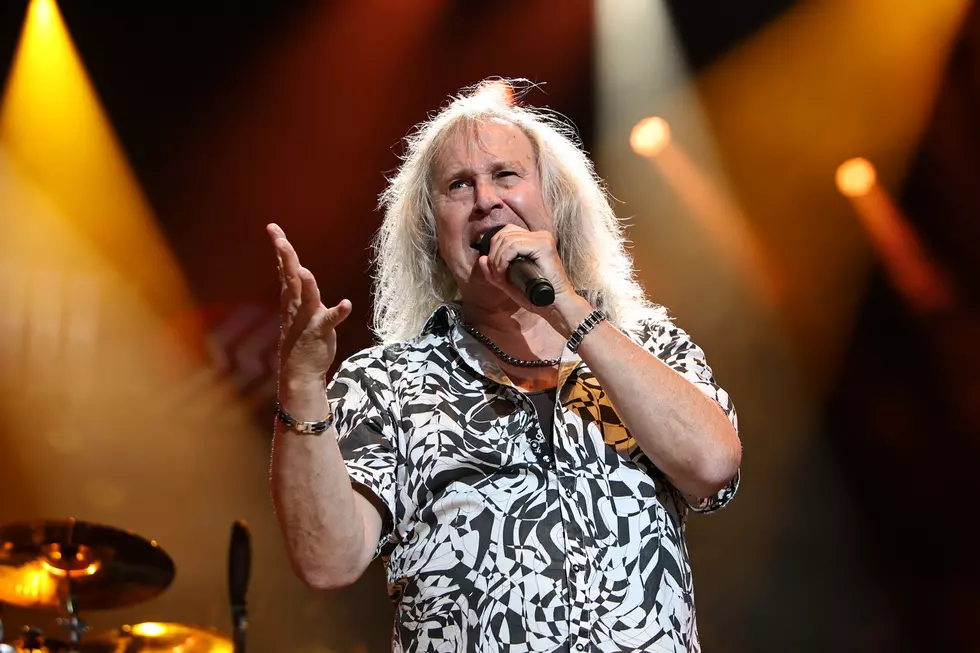

Ritchie Blackmore Wants to Play Live Again
Former Deep Purple guitarist and Rainbow mastermind Ritchie Blackmore has always loved performing live.
For the past 25 years, that's often meant something very different than what fans came to expect when they saw him play live with his main group. In that time period, Blackmore has indulged and further followed his true muse with his wife Candice Night in the band Blackmore's Night.
Their albums and concerts focus on a shared love of the tradition of Renaissance and folk-rock music. Last year however, it appeared like his time on stage might be coming to an end.
Their most recent tour in 2025, celebrating the quarter-century milestone of their group, had to be cut short due to health issues that he experienced while they were on tour. During today's conversation, Blackmore offers an update on his current health and how he hopes to return to the concert stage.
But he also looks back at his history with Deep Purple and how it led to the birth of his next band, Rainbow. A new box set for the latter, The Temple of the King: 1975-1976, offers a deep dive into the group's first two albums, 1975's Ritchie Blackmore's Rainbow and Rising, which followed in 1976.
A lavish booklet features liner notes by Rich Davenport, detailing what was going on with Blackmore and Rainbow in that time period and the set also includes three complete live shows from Nuremberg, Koln and Dusseldorf. There's also a bonus disc of additional rarities. In total, there are nine discs of material for fans to dig into, an appropriate deep dive.
Though interviews with Blackmore are rare these days, he agreed to field our questions, often giving lengthy answers that were thoughtful in tone and even sarcastically humorous at points. He even discussed, for the first time, the night that he was replaced by Christopher Cross in Deep Purple.
In the first part of our conversation, he details his health struggles and talks about his decision to leave Deep Purple, which opened the door for his future path with Rainbow.
Hey, Ritchie, thank you so much for doing this. It is greatly appreciated. To start, how are you feeling? Because fans, of course, have been concerned about your well-being, following your recent health struggles.
I woke up one morning when we were on tour and I had what is called vertigo. I don't recommend it to anybody. It was the worst thing I've ever been involved with. I've had heart problems, gout problems and pain, but vertigo is the worst thing I've ever been involved with. You're very dizzy to the point of where you have no control over any part of your body, and you just fall down, basically and you can't even think properly.
It's almost like a stroke, but you can speak and you can understand, which is different to a stroke and I had that in a hotel. I was taken off to the local hospital, where they kind of gave me the cure for vertigo. It's called epi movement [also known as the Epley Maneuver]. You have to move your head to the left and right and you have to take antihistamines, believe it or not. Taking those antihistamines is like taking something for seasickness.
It's like seasickness when you're at sea. It was like I was in a fishing boat at sea in the biggest gale you could imagine. I had to grab hold of anything I could find, like a chair to stop from falling down. That scared the hell out of me.
So we canceled the tour after that, came home and then it hit me again two days later, and it's not something I recommend for anybody to have. Because I always thought when people talk about vertigo, they're talking about, oh yeah, you feel a little bit dizzy. But it's not that. You think your whole world is ending right there. Every day now, I'm looking to the left and right and straining my neck, because that's where it's all coming from. But it's a bit of a mystery. I've found that at my age, being 150, that you know, it's time to kind of pull back on touring. I do not like traveling anymore. I love playing to anybody on any stage,
But to get to that place, sometimes the traveling makes me sick. When I was a child, and I would go with my mother on the Royal Blue to Bristol in England, to where most of our relatives lived, I would always throw up. I would be the age of nine or 10 and maybe that is what made me have a phobia about traveling. Now I seem to have a phobia, almost about traveling too far, leaving the comfort zone of one's home.
It's a very strange ailment to have. And so consequently, I want to do our next shows. I want to be on stage. I want to play. I'm still playing all the time, [But I] want to play within the radius of, like, 30 miles or 40 miles on the island.
We live on Long Island and I don't want to go hundreds of miles. Because that seems to upset my equilibrium. It's funny, I had forgotten how I reacted when I was a child, when I was nine and 10, how I would always throw up when I was traveling. So therein lies a mystery, [But I know] that I do like to be at home. So what I'm trying to do now is do dates that are closer to home.
READ MORE: Deep Purple Albums Ranked
I want to dig into this new Rainbow box set. What do you remember feeling as you started to work on putting the band together? How do you think you'd grown as a result of your time in Deep Purple and how do you think that informed what you wanted to do next, which ends up being Rainbow?
When I left Deep Purple, I just felt that the band wasn't pulling [its weight] as a musical venture. It became a committee. It was like if there were some answers to be had, there were five different answers. And I got a little bit tired of the committee meetings. But like what John Cleese said about Monty Python, I basically thought I'm going to get four other musicians where I don't. need to have a committee meeting and just get on with playing the music.
I needed some fresh blood. A bit like a vampire, I'm not a vampire -- I don't think I am. But it has been said [that I am], but I don't believe it. I just wanted a change. I felt that it was a stalemate. Everybody was into different things. I always remember the manager turning around to the band and saying, "Okay, guys, let's work out the tour for the next year." And it was in January, so straight away, it was "Okay. What about January the 25th starting in blah, blah, blah?" And somebody would speak up, "Oh, I can't make that. I have a wedding to attend to." "Okay, forget that...February? Let's do February." And then someone would pipe up, "Oh, I can't make that. I'm going on holiday in February."
Hear Deep Purple Perform 'Smoke on the Water'
And this went on, believe it or not, until about June or July. And I'm thinking, This is ridiculous. Everybody's got somewhere else to go or something else to do. What's happening with the band? Are we a band anymore, or are we just going on holiday and going to certain weddings? So that was just one of the reasons that I left. I also wanted to do this song called "Black Sheep of the Family," which I thought was a great song that we should do, whereas one of the members of the band said, "I don't want to do that song. We didn't write it, so we won't get writing credits."
I thought that was kind of ridiculous. And so I did it with Ronnie [James] Dio and we did it in an afternoon. And I really liked Ronnie's voice. We worked so quickly together. There was no committee meetings. He wasn't going on holiday or getting married or anything else. So things seemed to be going along quite quickly. And I said, I kind of like this, and that's when I decided to leave.
In the upcoming second part of our interview with Ritchie Blackmore, you'll hear the guitarist discuss how he and Dio grew their developing chemistry into their next project, Rainbow. He'll also share the history behind the songs and albums that followed.
Rainbow's work in that time period is preserved and expanded in the new box set, The Templie of the King: 1975-1976, which is available now\.
Deep Purple Lineup Changes: A Complete Guide
Gallery Credit: UCR Staff
More From Ultimate Classic Rock